Commitment in Times of Crisis: Prospects for International Environmental and Sustainable Development Regimes in 2026 and Beyond

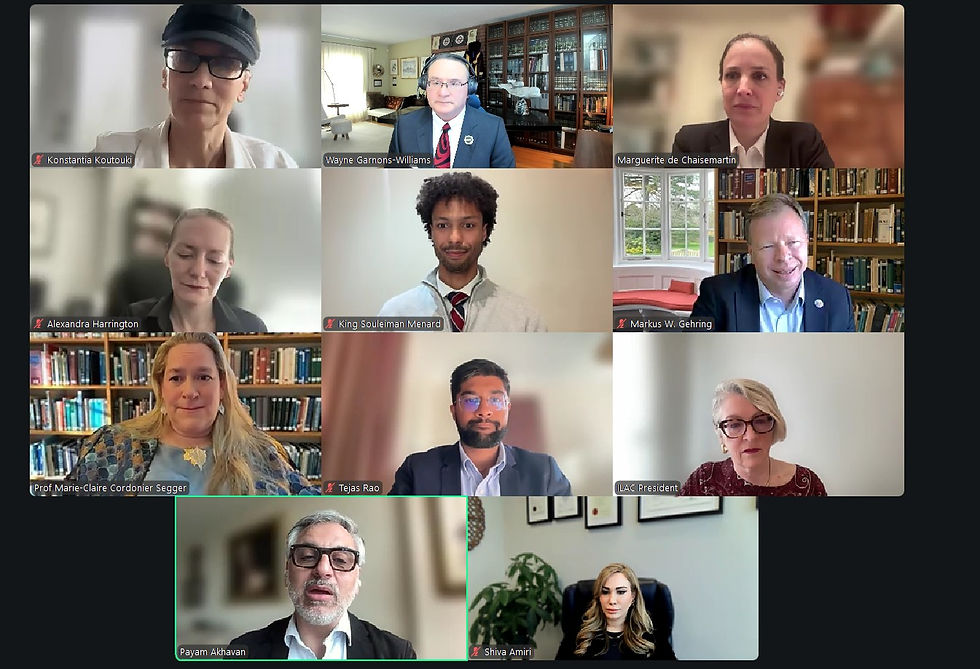
By Professor Marie-Claire Cordonier Segger and Professor Payam Akhavan, with thanks to Advocates Tejas Rao, Shiva Amiri and King Ménard, an international panel of ILA experts Professors Konstantia Koutouki, Markus Gehring and Wayne Garnons-Williams, also Drs Alexandra Harrington and Marguerite de Chaisemartin, and ILA-Canada President Dr Oonagh Fitzgerald.
International law on sustainable development and the environment involve living instruments — rules that grow stronger through sustained practice and compliance, or which can be weakened through neglect and abandonment. The treaty commitments that States have made to one another, and to future generations, were designed to enable development that can actually last: development that stewards the natural resources upon which all communities depend, that integrates environmental protection with economic advancement and social equity, and that respects the rights of those not yet born to inherit a livable planet. Yet we write at a moment when these very commitments face serious challenge — when powerful voices propose that treaty obligations are somehow optional, that national interest exists apart from planetary survival, and that promises solemnly made can be unmade whenever politically convenient. International law demands a response to this challenge. It demands courage, and the keeping of promises.
The regimes that give this body of law its practical force are numerous, interlocking, and, despite formidable headwinds, more scientifically grounded and legally sophisticated than at any prior moment in history. As Professor Konstantia Koutouki of the Université de Montréal, one of the world's leading authorities on the Convention on Biological Diversity, has argued, the challenge now before the international community is translating the ambition of agreed frameworks into verifiable action: "The Kunming-Montreal Global Biodiversity Framework has set bold targets, but what the international community must now deliver is the legal and institutional scaffolding that turns political commitment into accountable national implementation." With COP17 of the CBD approaching in Armenia, the question of whether parties will strengthen compliance review mechanisms and achieve genuine cross-sectoral integration of biodiversity obligations is among the most consequential facing international environmental governance. In the climate regime, Professor Markus W. Gehring of the University of Cambridge, whose research has shaped the trade and investment dimensions of the Paris Agreement, identifies an analogous structural challenge: "COP31 in Türkiye will be a critical test of whether the NDC ratchet mechanism can be made meaningful, especially as economic pressure mounts on countries to retreat from their most ambitious pledges." The UNFCCC process has produced remarkable legal architecture — but architecture requires maintenance, and compliance remains the central political question of our era.
Sustainable development law encompasses dimensions that extend well beyond the headline climate and biodiversity regimes. Professor Wayne Garnons-Williams, founding President of the International Inter-tribal Trade and Investment Organization (IITIO) and a leading scholar at the University of Waterloo, whose foundational contribution to drafting IPETCA has opened new pathways for Indigenous Peoples' participation in international economic law and whose new volume with Prof Marie-Claire Cordonier Segger of the University of Cambridge highlights the role of the UN Declaration on the Rights of Indigenous Peoples (UNDRIP) in inspiring Indigenous governance frameworks that are constitutive of sustainability: "Sustainable development cooperation rooted in Indigenous law and governance is not a side issue — it is a model for the kind of reciprocal stewardship obligations that all treaty regimes ultimately need to honour."
Further, in the domain of emerging international environmental instruments, Dr. Alexandra Harrington of the IUCN World Commission on Environmental Law, a foremost expert on the international governance of plastic pollution, has warned that ambition at the negotiating table must be matched by resolve in the final text: "A legally binding global instrument on plastics is within reach, but only if States resist the pressure to hollow out its substantive obligations before the ink is dry." And Dr. Marguerite de Chaisemartin, co-director of the International Waters Governance Research Initiative, a practitioner and scholar in international water law who served as legal adviser for Chile on the Silala Waters case before the International Court of Justice, highlights the momentum in international water law amidst significant challenges, pointing to recent new accessions to the global water conventions, and the transformative potential of SDG Indicator 6.5.2 reporting. She reminds us that: “Compliance relies on political will alongside strengthening the capacity and the mechanisms that can help bridge the gap between treaty obligations and on-the-ground reality."
Across these regimes, a common set of questions recurs with increasing urgency. How do committed States stay true to their treaty obligations when powerful actors seek to weaken these frameworks? What compliance mechanisms, governance innovations, and coalitions of the willing are most likely to sustain progress? How can the growing body of international jurisprudence — including the landmark advisory opinions issued by the International Tribunal for the Law of the Sea, the Inter-American Court of Human Rights, and now the International Court of Justice on States' climate obligations — be harnessed to build a more robust accountability architecture?
These are questions that Advocate Tejas Rao of the University of Cambridge has pressed across regimes, identifying where monitoring and accountability innovations are genuinely taking hold, and that Advocate Shiva Amiri has approached from the perspective of national legal systems and the domestic lawyers who must ultimately operationalise international commitments, also taking into account the human right to a clean, healthy and sustainable environment. Their analyses converge on a striking paradox: the legal tools are available, the scientific knowledge is sound, and the normative framework has never been more complete. What sometimes remains elusive is the collective political will to deploy these tools consistently, and to resist the erosion that follows when treaty obligations are treated as optional.
As Professor Payam Akhavan, who recently represented Bangladesh and small island States in the historic climate advisory proceedings before the International Court of Justice, has observed: "The advisory opinions emerging from international courts and tribunals are not abstract legal curiosities — they are the building blocks of a new accountability architecture that may prove transformative in ways we cannot yet fully anticipate." And as Professor Marie-Claire Cordonier Segger, Chair in Sustainable Development Law and Policy at the University of Cambridge and Senior Director of the Centre for International Sustainable Development Law notes “genuine crises threaten these fragile regimes, yet innovative legal techniques, strengthened scientific baselines, growing civil society mobilization, and emerging jurisprudence is also providing new implementation pathways. Perhaps this is what sustainable development law has always been about—not naïve optimism that treaties alone will save us, but rather the determined work of building legal infrastructure that can channel political will when it emerges, that constrains backsliding even when it can't compel progress, and that keeps alive the possibility of transformation even in dark times.”
The overarching message for international law on sustainable development in 2026 is one of determined realism. These regimes are under pressure — from political retrenchment, from the slow erosion that follows when powerful States treat treaty commitments as negotiable, and from a broader cultural moment in which short-term national interest is too often invoked to override the long-term obligations that sovereign nations undertook freely and solemnly. Yet the international law community is not retreating. It is generating new jurisprudence, building new coalitions of committed States, amplifying Indigenous knowledge and leadership, and developing educational initiatives that are expanding legal capacity precisely where it is most needed. A just and sustainable world requires legal infrastructure — infrastructure that must be built, defended, and renewed in every generation. That work continues.
The authors are grateful to Dr. Oonagh Fitzgerald, President of the International Law Association of Canada, and to all participants in the ILA-Canada online panel "Commitment in Times of Crisis: Prospects for International Environmental and Sustainable Development Regimes in 2026 and Beyond," held in partnership with CISDL on 29 April 2026, for the rich discussion and insights that informed this article. Speakers included Professor Konstantia Koutouki (Université de Montréal), Professor Markus W. Gehring (University of Cambridge), Professor Wayne Garnons-Williams (IITIO / University of Waterloo), Dr. Alexandra Harrington (IUCN World Commission on Environmental Law), and Dr. Marguerite de Chaisemartin (International Waters Governance Research Initiative), with discussants Advocate Tejas Rao (University of Cambridge) and Advocate Shiva Amiri (ILA-Canada), and online moderator Advocate King Ménard (University of Cambridge).